


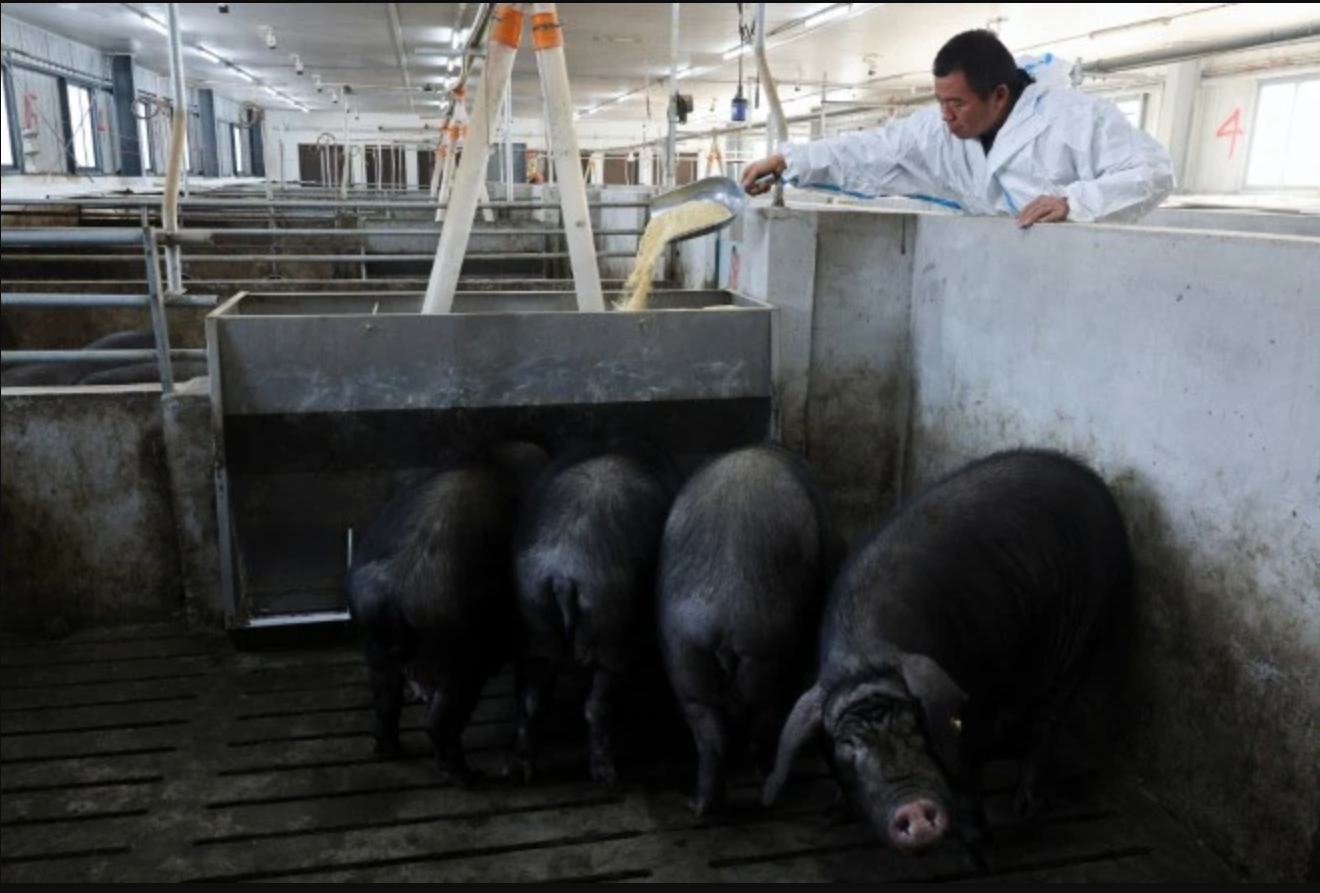
According to Reuters, interest in black pork is growing mainly among the urban middle class and older consumers, who associate it with the “taste of childhood,” when traditional black pigs were commonly raised by households. This pork is known for its higher fat content and more tender texture, which is why it is sometimes referred to as the “Wagyu of pork.”
Black pork can cost three to four times more than conventional pork. Despite the higher price, demand exceeds supply by 15–20%, analysts say. The premium segment remains one of the few profitable areas in the world’s largest pork market, which has struggled for years with overcapacity and weak demand.
Crisis in the mass pork market
China, which slaughtered around 720 million pigs in 2025 and produced 15.7 million tonnes of pork in the fourth quarter alone (the highest level since 2018), is now facing the downside of its scale. Due to a slowing economy, shifting consumer preferences and oversupply, pork prices in December were 14.6% lower than a year earlier.
Excess capacity is partly linked to government policies following the 2018 African swine fever (ASF) outbreak, when rapid herd rebuilding was encouraged. As a result, industry profitability has deteriorated sharply, and major producers are already reporting significant profit declines.
Black pigs as a survival strategy
For some farmers, black pork has become a way to offset losses. For example, Taizhou farmer Yang Xinchun earned more than 1 million yuan in net profit from 1,000 black pigs in 2025, compensating for losses from his 6,000 white pigs of Western breeds. He plans to significantly expand both his black pig herd and his chain of butcher shops.
According to industry experts, black pig numbers are already rising quickly in some regions. Large companies are also scaling up this segment, with leading producers announcing plans to make black pork a notable share of their business.
Analysts expect the number of black pigs in China to increase by 50% between 2024 and 2026, reaching 30–32 million head, or about 5% of the national herd.
A market without standards and with overheating risks
However, experts caution against excessive optimism. China has no unified standard for black pork, unlike, for example, Spanish Iberico ham. There are dozens of local black or black-spotted breeds, and crossbreeding with Western breeds is often used to speed up growth.
As a result, there is a risk the segment could quickly become oversupplied if too many producers rush into the “black pork” niche. Moreover, most consumers still prioritize low-priced pork.
Nevertheless, the current trend indicates that, in search of margins and stability, Chinese producers are increasingly turning to premium niches where quality, product story and consumer trust play a decisive role.